
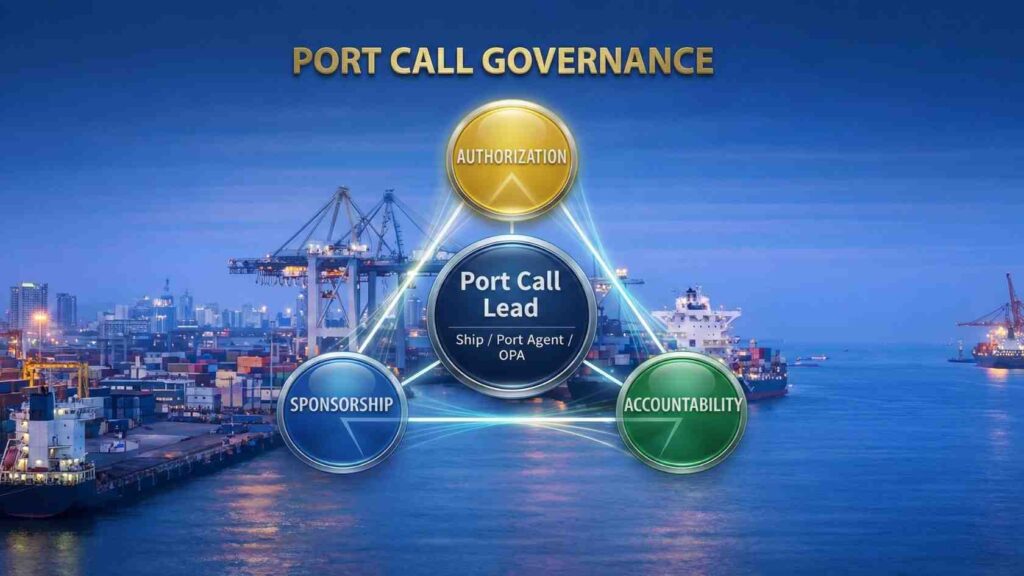
A Port Call Governance model for predictable outcomes, controlled cost, and audit‑ready compliance
This article is for general informational purposes. Requirements and practices can vary by port, terminal, cargo profile, and the specifics of each call. For port calls in Brazil, always align actions with your appointed Ship/Port Agent(s), Owners’ Protective Agent (OPA), and—when needed—your legal/compliance team.
1) Predictability in Brazil starts with one authorization chain
In Brazil, predictable port calls depend on a single, traceable chain of authorization and a central Port Call Lead—typically the appointed Ship/Port Agent(s) and, where applicable, an Owners’ Protective Agent (OPA).
Operational friction and compliance exposure most often arise when local suppliers receive parallel instructions or when supplier engagement becomes fragmented across multiple, uncoordinated channels.
In practice, this fragmentation can look like:
- vendors being mobilized informally (messages, calls, ad‑hoc emails),
- services being ordered without a clear sponsor,
- and operational decisions being taken without a defensible record of who requested, authorized, and remains accountable.
This is not about bureaucracy. It is about building a port call that is fast, predictable, and defensible—in front of authorities, terminals, and insurers.
2) The Ship/Port Agent as Port Call Lead: authority, sponsorship, traceability
In Brazil, the Ship/Port Agent is not simply a coordinator. The appointed Ship/Port Agent(s) provide the formal interface between the vessel and the local port ecosystem, typically including:
- Port Authority / Port Administration
- Customs
- ISPS / Port Security
- Maritime Authority (where applicable)
- Other competent authorities and critical facility stakeholders
In a regulated environment, one distinction matters more than any invoice or WhatsApp message:
A vendor may execute a task. An agent carries authority.
Suppliers can perform work. The Port Call Lead carries the formal authority, sponsorship capability, and accountable traceability required to keep a call stable and compliant.
3) Orphan responsibility: the hidden cost of fragmented execution
Fragmented vendor engagement creates a subtle but powerful risk: orphan responsibility.
During audits, inspections, security checks, or incidents, questions are predictable:
- Who formally requested the service?
- Who authorized it?
- Who sponsored access into controlled areas?
- Under what mandate or authority?
- Who answers if something goes wrong?
When multiple parties issue instructions in parallel, answers fragment into:
- “the charterer asked,”
- “the ship told us,”
- “we were just supporting,”
- invoices without clear authorization context.
In regulated environments, informal authority is not authority.
What cannot be traced, cannot be defended.
What cannot be traced, cannot be defended.
4) Vendor selection discipline: operational capability ≠ regulatory legitimacy
Brazil port calls often require local vendors. The critical point is how they are mobilized and what they are being asked to do.
Many vendors can deliver, transport, repair, collect waste, or provide husbandry support. But some activities require formal legitimacy, not just operational capacity.
This distinction matters:
Operational capability does not equal regulatory legitimacy.
A vendor may be technically competent and well‑intentioned yet still be the wrong party to:
- act as the vessel’s representative before authorities,
- request port services/facilities “in the name of the vessel,”
- sponsor access into controlled or restricted areas,
- or stand behind an auditable authorization chain.
The commercial takeaway is simple: mobilize vendors through the Port Call Lead, so every critical action remains accountable and traceable.
5) ISPS and controlled areas: sponsorship is part of performance
Brazilian ports operate under ISPS‑related security frameworks with controlled entry points, credential requirements, recorded purposes, CCTV coverage, and audit trails.
In practical terms, controlled or restricted access requires:
- a valid credential,
- a documented purpose,
- and a traceable sponsor who stands behind the entry.
When sponsorship is unclear—or when access decisions are handled through informal channels—security governance weakens and audit exposure increases. This is not a minor detail: it can affect operational continuity, response time, and the port call’s overall defensibility.
Best practice is to treat sponsorship as a performance requirement, not merely a compliance checkbox.
6) Customs and regulated environments: Brazil runs on formal responsibility
Brazilian port calls frequently intersect with customs‑controlled routines and documentation requirements, especially in contexts involving:
- ship spares / materials in transit
- equipment and stores
- waste and disposals
- cargo‑adjacent movements
- interactions within controlled or monitored areas
Even when operational intent is legitimate, the compliance lens is consistent:
who requested what, under whose authority, and what records support it.
who requested what, under whose authority, and what records support it.
When authorization and documentation are fragmented, the call may face:
- delays,
- inspections,
- disputes over responsibility,
- enforcement actions depending on circumstances and findings.
Brazil is not unique in requiring formal representation. What makes Brazil different is the level of formality, auditability, and multi‑authority oversight involved in port calls.
7) Risk allocation reality: when authorization is fragmented, exposure stays with owners/charterers
This is where “commercial convenience” turns into “commercial exposure.”
When the call is centralized through the Port Call Lead
- responsibility is structured,
- actions are traceable,
- requests and approvals are auditable,
- accountability is clear,
- risk is allocated in a defensible way.
When vendor engagement is managed through parallel instruction streams
- documentation fragments,
- sponsorship becomes unclear,
- accountability becomes disputed,
- exposure remains with the owner/charterer.
This also matters for incident handling:
From an insurance and claims‑handling perspective, unclear authorization and traceability materially complicate incident analysis and recovery.
The business outcome is straightforward: a clean authorization chain is a form of risk transfer and defense, not paperwork.
8) Total cost of execution: fragmented vendor engagement rarely reduces cost
Fragmentation is often justified as “faster” or “cheaper.” In practice, it commonly creates:
- duplicated services (two parties mobilized for the same task),
- emergency corrective actions under time pressure,
- berth window loss and delay costs,
- invoices that cannot be validated or defended,
- disputes between suppliers with the shipowner caught in the middle.
The most expensive outcomes are usually the avoidable ones:
paying to fix what should not have happened.
paying to fix what should not have happened.
9) Multi‑authority risk: why governance gaps become a port ecosystem issue
Governance gaps do not remain “commercial issues.” When sponsorship, authorization, and traceability are unclear, the risk can become a port ecosystem problem, because different authorities and stakeholders view the same weakness through different lenses:
- Port Authority / Port Administration: focused on operational governance in a regulated port environment—procedural discipline, control over who operates where, and the ability to demonstrate order and accountability during inspections and reviews.
- ISPS / Port Security Unit: focused on access control fundamentals—sponsor identity, purpose validation, logs, CCTV, and audit trails. Governance gaps can translate into adverse audit findings.
- Brazilian Customs: focused on formal responsibility—who is the responsible party, what is the documentary trail, and whether actions can be linked to a legitimate chain of authority. Missing mandate/sponsorship may raise compliance vulnerability and trigger scrutiny depending on circumstances and findings.
- Federal Police: focused on integrity of controlled areas, irregular access patterns, and systemic weaknesses in access controls—particularly where sensitive events or repeated deviations exist depending on circumstances and findings.
- Port security governance bodies (e.g., CESPORTOS): focused on local security governance and coordination, especially where repeated patterns suggest weakening of access control and traceability.
- Regulatory oversight (e.g., ANTAQ): focused on the broader governance environment and compliance posture of the port ecosystem, where recurring traceability failures can drive oversight attention and corrective expectations (without assuming any specific sanction outcome).
- Facility stakeholders / critical operators (where applicable): focused on low tolerance for access failures, sponsorship gaps, and unclear accountability—often leading to operational restrictions or contractual responses in the interest of security and continuity.
When traceability breaks, this is not perceived as an isolated vendor issue. It can appear as a governance weakness.
This is why ports enforce sponsorship and traceability: they are protecting security—and their own regulatory standing.
10) How to choose a qualified Ship/Port Agent in Brazil (due diligence)
In Brazil, selecting the right Ship/Port Agent is a risk decision—not just a procurement decision.
A practical due diligence step is to check whether the agent is connected to recognized professional networks and national associations commonly used by the industry.
Internationally, FONASBA is a federation of national associations of ship brokers and agents and publishes member information, including listings by country/association. In Brazil, FENAMAR is a national federation representing ship agents and participates in sector initiatives that can support professional standards and training.
Choose safely: use reputable networks and verify the agent’s ability to provide formal sponsorship and traceable representation.
Practical verification steps:
- Can the agent clearly define roles (Full Agent vs OPA vs Charterer’s Agent) for the call?
- Can the agent demonstrate capability to sponsor controlled‑area access properly?
- Does the agent maintain auditable records and structured authorization flows?
- Does the agent operate with a compliance posture consistent with regulated port calls?
This does not replace legal vetting—but it is a strong first layer of risk reduction.
11) Checklist: Before you mobilize any local supplier in Brazil
Before committing to any local supplier engagement, ask:
- Is the request centralized through the appointed Port Call Lead (Ship/Port Agent / OPA)?
- Who sponsors access (especially into controlled or restricted areas)?
- Who answers to authorities if questioned?
- Where is the authorization trail (not just an invoice)?
- Can this be defended in an audit?
If any of these answers are unclear, treat it as a risk signal and pause.
12) Conclusion: predictable calls are built, not improvised
Brazil is a regulated environment. Predictable port calls are not achieved by improvisation—they are built through centralized authorization, traceable sponsorship, and clear accountability.
The appointed Ship/Port Agent (and, where applicable, the Owners’ Protective Agent) is not a cost line to optimize away. It is a compliance, security, and risk‑management asset—and a performance enabler.
Before mobilizing any local supplier in Brazil, validate the request through your trusted Ship/Port Agent or Owners’ Protective Agent acting as your Port Call Lead.
About Costa Maritime
Costa Maritime supports shipowners and operators in Brazil with compliant, secure, and fully traceable port calls—built on clear authorization chains, proper sponsorship, and accountable interfaces with authorities and critical stakeholders.